
The Low Back Pain Implementation Collaborative brings together more than 30 stakeholders, including health care purchasers, health plan leaders, health care providers, and experts to work on solutions to address the treatment of acute low back pain. It is estimated that 80% of Americans will have some form of back pain in their lifetime, but not all of them will receive high-quality health care to address it.
In Washington state alone, the latest data shows that approximately 72,000 people with low back pain received more than 140,000 low-value services at an estimated cost of nearly $10 million in 2020.
View the full list of collaborative participants and subject matter experts.
An Equitable Approach to Addressing Acute Low Back Pain
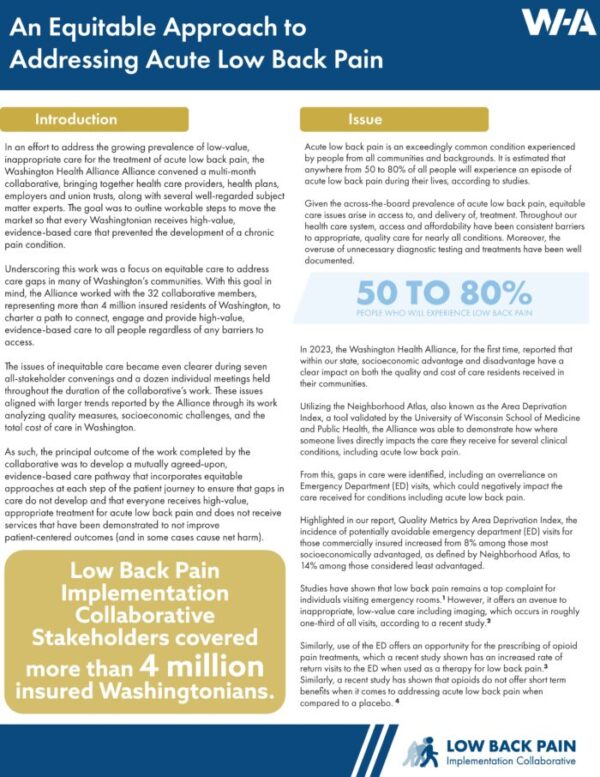
"To have quality in the treatment of acute low back pain, there needs to be equity."
A key focus of the Acute Low Back Pain Implementation Collaborative was to ensure equitable care. Throughout 18 months of work, the collaborative crafted each step of the care pathway to include efforts to address inequities and fill care gaps. In this paper, the collaborative outlines steps to ensure equity in the screening and treatment of acute low back pain through each of the five steps of the care pathway, highlighting specific efforts each stakeholder group took to ensure access. Read the full white paper.
Why Washington Health Alliance Is Tackling Acute Low Back Pain
Low back pain is one of the most prevalent and costly health problems in the United States — and one of the most poorly managed. An estimated 80% of Americans will experience some form of back pain in their lifetime, yet widespread misconceptions, fragmented care models, and the routine use of ineffective treatments prevent most patients from getting the help they need.
As early as 1985, research showed the benefits of motion in the healing process. Yet decades later, barriers to optimal evidence-based management remain: "misconceptions of the general public and health professionals about the causes and prognosis of low-back pain and the effectiveness of different treatments, fragmented and outdated models of care, and the widespread use of ineffective and harmful care." (The Lancet)
Washington Health Alliance data confirm the problem is acute in this state. WHA's All-Payer Claims Database — one of the most comprehensive multi-payer datasets in the country — positioned the Alliance to identify the scale of the problem and lead a coordinated response across all stakeholder groups.
Low Back Pain in Washington State
- Approximately 72,000 people in Washington state received low-value care for low back pain in 2020.
- More than 140,000 unnecessary services — including X-rays, MRIs, CT scans, and inappropriate opioid prescriptions — were delivered that same year.
- The estimated cost of that low-value care: nearly $10 million in a single year.
- 80% of Americans will have some form of back pain in their lifetime.
- Studies as early as 1985 showed the benefits of motion in the healing process.
- A review of social determinants of health across 17 countries found important associations between gender, race, ethnicity, education, occupation, and socioeconomic status and low back pain. (IASP)
Read more Read less
The Problem With How We Treat Low Back Pain Today
Despite decades of evidence that active, conservative care produces the best outcomes, patients across Washington state continue to receive unnecessary imaging, opioid prescriptions, and surgical referrals. One of the most common low-value services identified in WHA's purchaser data was the prescription of opioids for low back pain. A 2023 landmark trial confirmed what the evidence has long suggested: opioids for back pain perform no better than placebo.
Catching low back pain within the first three months is critical — both to alleviate unnecessary doctor visits and to improve the likelihood that symptoms can be appropriately treated. Yet the first visit too often sets patients on the wrong path.
The Cost of Inaction
Analysis of eight large employer/purchasers in Washington found that approximately 20% of individuals received at least one low-value service, and more than $320 million was spent on low-value care. There was a higher rate of low-value care delivery — approximately 10% more per year — for those populations compared to the state average.
Downstream, low-value imaging triggers cascade services and spending: each unnecessary scan leads to follow-up appointments, specialist referrals, and procedures that compound cost without improving outcomes.
Education and Behavior Change Are the Levers
Evidence shows that both providers and patients benefit from education. Providers are more likely to produce the best outcomes when they have the right tools to triage the patient and direct them down the right care pathway. Patients also benefit — especially from understanding that long periods of bed rest can prevent recovery. As the research puts it: motion is lotion.
Catching the patient early, triaging correctly, and redirecting toward high-value conservative care are not complicated ideas. The barrier is coordination, accountability, and aligned incentives — precisely what a multi-stakeholder collaborative is built to address.
Washington Health Alliance Is Built for This Moment
WHA's All-Payer Claims Database spans payers, employers, and providers across the state — giving the Alliance a view of care patterns that no single organization could see on its own. Building on the first phase of the Driving Value Project (which delivered low-value care reports to eight large purchasers), the Alliance expanded the work into a full implementation collaborative supported by Arnold Ventures' Provider Payment Incentives Portfolio.
The mission: advance the market to improve the value of care for all patients with low back pain in Washington state.
Read lessWhile I was initially cautiously optimistic, you pulled off a multi-stakeholder initiative in which people who, at the onset, you’d like to believe had differing incentives and aims, actually came together around meaningful clinical equity and efficiency, that could not only bring about short term significant gains but could also be a template to a much broader approach as we deal with issues of inequity, inefficiency and misallocation of healthcare resources.
Mark Fendrick, MD Professor, Dept. of Internal Medicine and Health Management and Policy, University of MichiganDirector, University of Michigan Center for Value-Based Insurance Design
How the Collaborative Built an Evidence-Based Care Pathway
The collaborative's core product is a five-step Acute Low Back Pain Care Pathway — a clinically validated, equity-centered framework for how patients with low back pain should move through the health care system. Building it required 18 months of structured work across health plans, providers, purchasers, and expert advisors.
The pathway was not developed by any single organization or discipline. It was built through a process that brought competing interests and complementary expertise into the same room — and kept them there long enough to reach agreement on actionable recommendations.
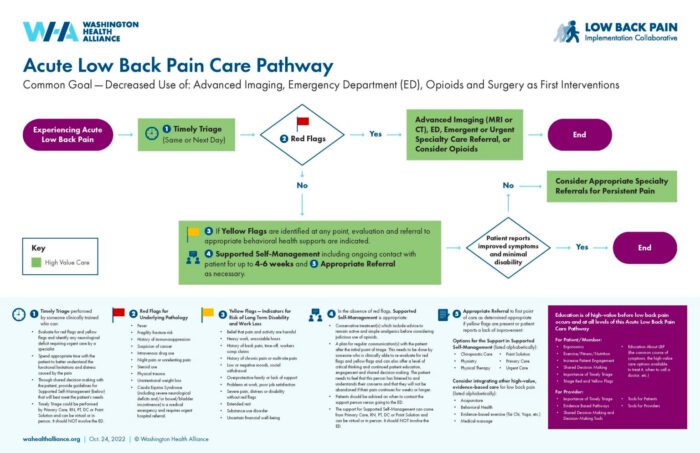
Care Pathway
Acute Low Back Pain Care Pathway
The five-step framework defining evidence-based care actions for health plans, providers, and purchasers at each stage of the patient journey.
Download PDF →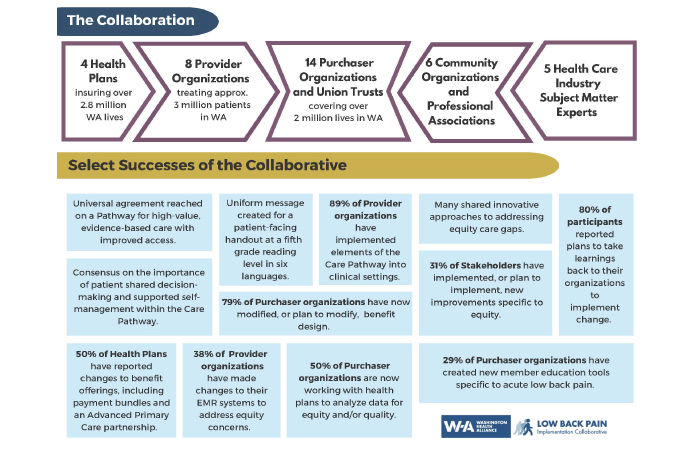
Implementation
Stakeholder Successes
A summary of progress and actions taken by collaborative members across all stakeholder groups during the collaborative period.
Download PDF →Read more Read less
Starting With the Evidence
Since the beginning, the collaborative reviewed and incorporated the leading research on acute low back pain treatment. Key sources included:
- Low Back Pain Guidelines and Recommendations — Dr. Robert Bree Collaborative, Foundation for Health Care Quality
- Health Insurance Design and Conservative Therapy for Low Back Pain — American Journal of Managed Care
- Active Rehabilitation of Work-Related Low Back Conditions — WA Dept. of Labor and Industries
- Comparative effectiveness and safety of analgesic medicines for adults with acute non-specific low back pain — BMJ
Advisors Who Shaped the Work
Four national subject matter experts served as advisors throughout the 18-month collaborative:
- Dan Cherkin, PhD — Affiliate Professor in Family Medicine, University of Washington; Director of Research, Osher Center for Integrative Medicine; Emeritus Senior Scientific Investigator, KP Washington Health Research Institute
- Mark Fendrick, MD — Director, Center for Value-Based Insurance Design; Professor, Internal Medicine and Health Management and Policy, University of Michigan
- Andrew Friedman, MD — Section Head of Physical Medicine & Rehabilitation, Virginia Mason Medical Center; Chair, Industrial Insurance Medical Advisory Committee, Dept. of Labor
- Joshua Liao, MD, MSc, FACP — Associate Professor of Medicine; Associate Chair for Health Systems, Dept. of Medicine; Adjunct Associate Professor, Health Systems and Population Health, University of Washington
Stakeholder-Specific Implementation Resources
These resources apply equally to health plans, providers, and purchasers and are free to share:
A Policy Brief for Decision-Makers
Following 18 months of work, the collaborative and WHA produced a policy brief outlining recommendations for avoiding low-value, ineffective care for acute low back pain. The brief details the broad workforce impact of low back pain and outlines clear steps to ensure everyone can return to a pain-free life.
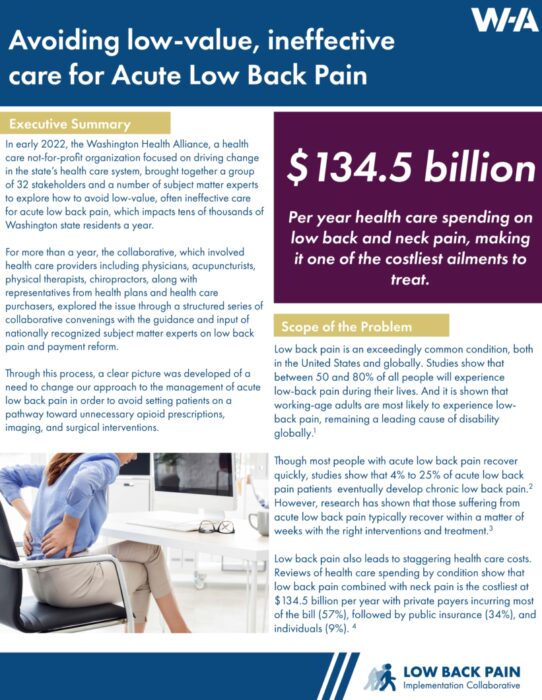
Policy Brief
Recommendations for Avoiding Low-Value Care for Acute Low Back Pain
Clear, actionable recommendations for health plans, providers, and purchasers — with a focus on workforce impact and return to function.
Download PDF →One Year Later
One year after the collaborative completed its work, WHA asked stakeholders to share the progress they had made implementing actions to address acute low back pain.
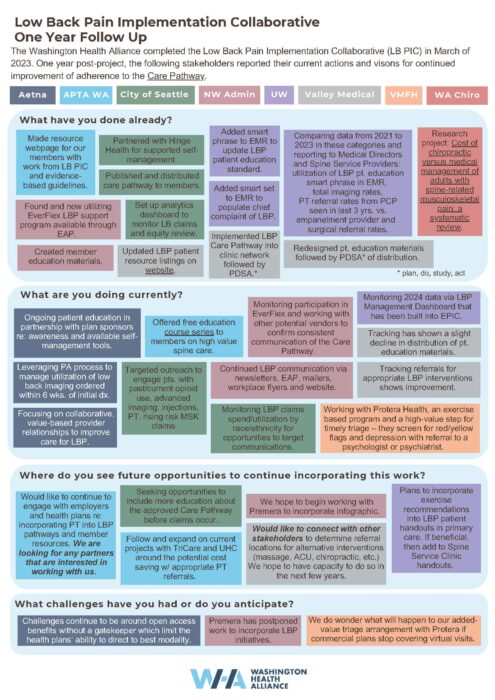
Progress Report
One-Year Progress: Implementation in Action
How collaborative organizations put the care pathway into practice — one year after the work concluded.
Download PDF →It was really helpful for my team and me to go through this together because we’re engaged in trying to spread some best practices throughout VMFH. This was a platform that really increased the connectivity of our group around our intentions with this. Our Director has since taken and run with some of the initiatives that we had.
Andrew Friedman, MD Physical Medicine and RehabilitationVirginia Mason Franciscan Health
Who Was Involved and What Actions They Took
The Low Back Pain Implementation Collaborative launched in February 2022 as the second phase of WHA's Driving Value Project, building on an earlier round of purchaser-focused low-value care analysis. The collaborative brought together 30 participant organizations with a shared mission: advance the market to improve the value of care for all patients with low back pain in Washington state.
Participants represent all major stakeholder groups — commercial insurance plans, large employer/purchaser organizations, union health trusts, provider groups, professional associations, and public agencies. Each stakeholder group engaged in both all-collaborative convenings and group-specific meetings to address the unique issues facing plans, providers, and purchasers. The Collaborative is supported by Arnold Ventures' Provider Payment Incentives Portfolio.
Read more Read less
Participants commit to specific, accountable actions. A May 2022 collaborative-wide survey documented the following actions underway by stakeholder group:
Health Plans
- Setting up telemedicine visits as a first stop for triage
- Directing members to a 24-hour nurse line
- Providing education to members on how to self-manage pain
- Improving an online member portal
- Providing more non-surgical care options
- Implementing prior authorizations for advanced imaging and surgery
Health Care Providers
- Educating primary care providers about care center options
- Instituting baselines to understand the prevalence of low-value care
- Tracking calls to primary care clinics to find out how many result in an Emergency Department or Urgent Care visit
- Referring patients to care options sooner
- Reviewing, updating, and developing patient education materials
- Considering how equity is reflected in care for those with low back pain
Health Care Purchasers (Employers and Union Trusts)
- Informing members on the difference between acute and emergent low back pain
- Considering bundled payment models to allow for more integrated services
- Incentivizing the first point of contact to be with a primary care provider, rather than the Emergency Department
- Promoting health coaching program options to members
- Informing members with a history of chronic low back pain of free treatment options
- Tailoring benefit design to evidence-based treatment recommendations
Health Care Allies
- Building awareness of the problem of inconsistent treatment for low back pain
- Creating purchasing and payment standards that use consistent care quality metrics
- Supporting the use of shared decision making including pain education, self-care, and effective triage
- Working towards producing information videos and investing in educational tools for all stakeholders
Participant Organizations
Aetna | American Physical Therapy Association | Aon | Association of Washington Cities | Bloodworks Northwest | City of Seattle | Confluence Health | Davis Wright Tremaine | Dr. Robert Bree Collaborative | Kaiser Permanente Washington | King County | MultiCare Health System | Point B | Port of Seattle | Premera Blue Cross | Proliance Surgeons | Regence BlueShield | SEIU 775 Health Benefits Group | Seattle Metropolitan Chamber of Commerce/Business Health Trust | The Boeing Company | UFCW 21 | UW Medicine | Virginia Mason Franciscan Health | Washington Acupuncture and Eastern Medicine Association | Washington Health Benefit Exchange | Washington Optum Care | Washington State Chiropractic Association | Washington State Department of Labor and Industries | Washington State Health Care Authority | Washington Teamsters Welfare Trust
I really valued the variety of people that were present, and it was helpful for everyone to see other angles of the problems and potential solutions. I appreciate your efforts to get big decision-makers all in the room together.
Morgan Young, DC Associate Medical Director for ChiropracticState of Washington Department of Labor & Industries
How the Work Came Together
October — Collaborative Announced
Building on the Driving Value Project (Phase 1, supported by Arnold Ventures), WHA announced the Low Back Pain Implementation Collaborative and invited stakeholders to join. Phase 1 engaged purchaser members covering 550,000 plan participants and produced a whitepaper on low-value care.
February — All-Stakeholder Kickoff
29 participant organizations gathered for the first all-stakeholder meeting, establishing three priority tracks for purchasers, plans, and providers. Expert advisors Friedman, Liao, and Fendrick addressed the group.
April — Expert Advisor Session
All four expert advisors — Cherkin, Fendrick, Friedman, and Liao — convened with the collaborative to consider opportunities and recommendations for improving care delivery.
May — Stakeholder Progress Survey
A collaborative-wide survey documented actions underway across health plans, providers, purchasers, and allied organizations. WHA presented findings at the Civitas Networks for Health Member Roundtable.
18 Months of Work — Care Pathway Developed
Over 18 months, the collaborative developed the five-step Acute Low Back Pain Care Pathway and accompanying implementation resources — including patient handouts in six languages, stakeholder-specific action guides, measurement and code sets, and shared decision-making guidelines.
August — Policy Brief Published
The collaborative and WHA published the Low Back Pain Policy Brief, outlining recommendations for avoiding low-value, ineffective care across all stakeholder groups.
October — White Paper: An Equitable Approach
WHA published the equity-centered white paper documenting the collaborative's approach across each of the five care pathway steps.
August — One-Year Progress Report
One year after the collaborative concluded, WHA released a one-year infographic documenting how stakeholder organizations implemented actions from the care pathway.
The Alliance team addressed a very complex topic and produced an easy to follow product with the Care Pathway.
Charlene Lind VP Client RelationsWA Teamsters Welfare Trust
Tools and Materials for All Stakeholders
As part of its ongoing effort, the collaborative has collected resources highlighting work to address the issue. All materials are free to share.
Equity
Patient Education
Patient Handout Infographics (PDF)
Word Templates (.docx)
Newsletter Template
Integrative Care Options
Acupuncture
- Acupuncture for Acute Low Back Pain (video)
- Washington Directory of Licensed Acupuncturists — NCCAOM
- Washington Directory of Medical Acupuncturists — American Association of Medical Acupuncture
Chiropractic Care
- Chiropractic Care for Acute Low Back Pain (video)
- Washington Directory of Chiropractors — Washington State Chiropractic Association
Physical Therapy
Changing Behaviors
Dr. Josh Liao, board-certified internal medicine physician and medical director of payment strategy at UW Medicine, shares information on changing patient behavior. Liao served as a subject matter expert to the collaborative.
Research
- Low Back Pain Guidelines and Recommendations — Dr. Robert Bree Collaborative
- Health Insurance Design and Conservative Therapy for Low Back Pain — American Journal of Managed Care
- Understand Access to Covered Treatment and Services for People with Chronic Pain — CMS
- Active Rehabilitation of Work-Related Low Back Conditions — WA Dept. of Labor and Industries
- Initial Management of Acute and Chronic Low Back Pain — Journal of Alternative and Complementary Medicine
- Comparative effectiveness and safety of analgesic medicines for adults with acute non-specific low back pain — BMJ (2023)
- Landmark Trial: Opioids for Back Pain No Better Than Placebo — Medscape
Bibliography
- Qaseem A, Wilt TJ, McLean RM, et al. Noninvasive Treatments for Acute, Subacute, and Chronic Low Back Pain: A Clinical Practice Guideline From the American College of Physicians. Ann Intern Med. 2017;166:514–530. doi:10.7326/M16-2367
- Cherkin DC. How Can the Intractable Problem of Chronic Musculoskeletal Pain (CMP) Be Effectively Managed? J Gen Intern Med. 2018;33(Suppl 1):4–6. doi:10.1007/s11606-018-4362-5
- Foster N, Anema J, Cherkin D, et al. Prevention and treatment of low back pain: evidence, challenges, and promising directions. The Lancet. 2018;391. doi:10.1016/S0140-6736(18)30489-6
- Navathe AS, Liao JM. Aligning Value-Based Payments With Health Equity: A Framework for Reforming Payment Reforms. JAMA. 2022;328(10):925–926. doi:10.1001/jama.2022.14606
- George SZ, Goertz C, Hastings SN, Fritz JM. Transforming low back pain care delivery in the United States. PAIN. 2020;161(12):2667–2673. doi:10.1097/j.pain.0000000000001989
- O'Connor DA, Glasziou P, Maher CG, et al. Effect of an Individualized Audit and Feedback Intervention on Rates of Musculoskeletal Diagnostic Imaging Requests by Australian General Practitioners. JAMA. 2022;328(9):850–860. doi:10.1001/jama.2022.14587
- Korenstein D, Gillespie EF. Audit and Feedback — Optimizing a Strategy to Reduce Low-Value Care. JAMA. 2022;328(9):833–835. doi:10.1001/jama.2022.14173
- Schwartz MR, Cole AM, Keppel GA, et al. Complementary and Integrative Health Knowledge and Practice in Primary Care Settings. Global Advances in Health and Medicine. 2021;10. doi:10.1177/21649561211023377
- Dhruva SS, Bachhuber MA, Shetty A, et al. A Policy Approach to Reducing Low-Value Device-Based Procedure Use. Milbank Quarterly. 2022;100:1006–1027. doi:10.1111/1468-0009.12595
- Ganguli I, Ying W, Shakley T, et al. Cascade Services and Spending Following Low-Value Imaging for Uncomplicated Low Back Pain among Commercially Insured Adults. J Gen Intern Med. 2022. doi:10.1007/s11606-022-07829-2
- Wewege MA, Bagg MK, Jones MD, et al. Comparative effectiveness and safety of analgesic medicines for adults with acute non-specific low back pain: systematic review and network meta-analysis. BMJ. 2023;380:e072962. doi:10.1136/bmj-2022-072962