
Member Resources
Obesity Workgroup
The Alliance convened a workgroup of large public and private employers, and union trusts over four months to identify and act upon opportunities for improvement in their health and wellness offerings to improve care for their workforce of people living with obesity.
The Alliance included clinical research as a model, including Prevention and Screening, Behavior Therapy, Pharmacotherapy, Surgery, and Weight Maintenance.
The Alliance shared other publicly available clinical pathways and provided information to educate members.
Thank you to the Midwest Business Group on Health for access to an Obesity Management Toolkit, full of employer-focused resources from addressing obesity through employee benefits to business cases and economics.
Member Checklist
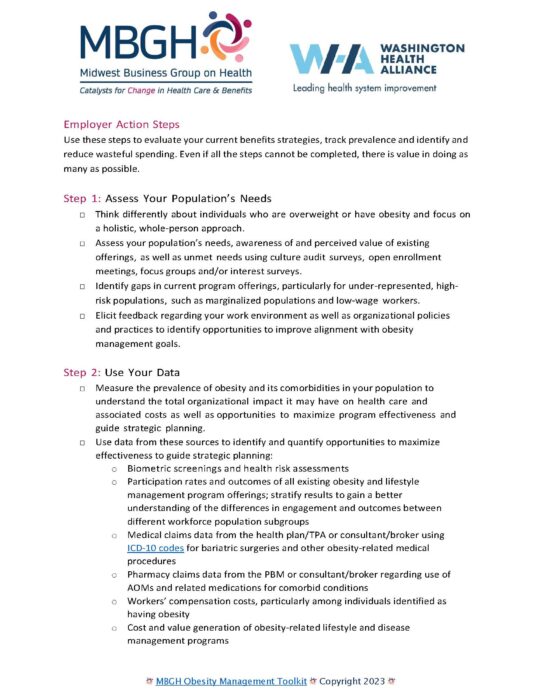
Read the Full Employer Action Steps
With our partners, Midwest Business Group on Health, the Alliance has created a checklist of steps for members to evaluate current benefits strategies and track and identify wasteful spending.
While it may not be possible to complete all steps of the checklist, there is clear value for your organization in completing as many as possible.
If you have any questions about the Employer Action Steps, please contact Denise Giambalvo, Director of Member Engagement & Business Strategy, at dgiambalvo@wahealthalliance.org.
Employer No. 1
Employer #1:
Employer Facts
• Industry: Public Sector Benefit Trust
• Number of Medical Covered Lives in WA: Over 30,000
• Scope of Coverage: HMO and PPO plan options
Challenges
“We are an Association coordinating benefits for 270 employer groups/locations state-wide. Our employees have two medical carriers to choose from and we’ve found that while there is higher enrollment in one plan than the other, the plan with the lower enrollment has a higher percentage of enrollees with obesity. Getting desired claims data from health plans has been challenging – coding rates for obesity are generally low, as it’s not a diagnosis that is often used, which is further complicated in that we are unable to pull claims data for more than one diagnosis at a time to capture any of the conditions identified as common comorbidities and occurring with a diagnosis of obesity. Another challenge we acknowledge is our current lack of coverage for any weight loss medications.”
Solutions
• Using a data warehouse provides data that we find to be more accessible
• Being in the field and talking to members allows us to assess what benefits are important to them
• A combined and broad approach of many different wellness programs addressing obesity and its commonly concurrent conditions, including: dietary coaching, mental health coaching, general health coaching, consulting nurse, condition management, no member cost EAP, quarterly wellness newsletter, staff trainings including annual Healthy Worksite Summit, personalized wellness app, mini-grants to fund education, activities or equipment that help build healthy workplace cultures and address employee’s health risks, interests and priorities
• Dedicated Health Promotion staff
• Avenues for member feedback exist via Employee Benefit Advisory Committee and Board of Trustees
• Adopted 1/2023: Bariatric surgery benefit through carrier’s Centers of Excellence ($35k lifetime max) and unlimited visits for nutritional counseling
• Considering implementing telehealth Point Solution in 2024 to add care options for the many MSK issues that often accompany obesity.
Results
• We’ve seen multiple member testimonials stating that current coverage for bariatric surgery, MSK conditions and nutritional counseling (which has unlimited visits) keep people from missing work
• Thorough review of data is allowing us to better consider what makes sense for our member populations
• The need to further investigate coverage for weight loss medications for patients with diabetes diagnosis is now on our radar as possible future focus
• The culture for consistent health and wellness messaging and normalizing utilization of EAP resources has been created and maintained among our many employer groups
• Upper 20% utilization rate of EAP
Employer No. 2
Employer #2:
Employer Facts
• Industry: Public
• Number of Covered Lives in WA: 15,000
• Scope of Coverage: HMO and PPO plan options
Challenges
“We’ve found claims data from one of our plans to be less transparent and less readily available and our current data may be inflating patient counts when a patient has multiple diagnoses. The data needs more analysis. We need to review current lifestyle modification programs for more condition specific and culturally competent. We’ve seen poor program utilization and an employee focus group has expressed resistance for one vendor due to perceived obesity bias and lack of cultural representation. Our members have requested more coverage for weight management, and we have also seen escalating cost of GLP-1 prescriptions for off-label use without a diabetes diagnosis.”
Solutions
• The bulk of our efforts have been considering and re-considering our approach to obesity support in the full spectrum of health (prevention to complex/advanced)
• Current benefits for bariatric surgery with Centers of Excellence, nutritional counseling coverage, condition management and support for MSK issues occurring with obesity were reviewed and found to be adequate, but we identified opportunities in the areas of lifestyle modification and pharmacotherapy:
More Data Analysis
• Investigate type of care and location of care for obesity patients – PCP attribution
• Collect more data where it is currently missing Benefit Change Considerations
• Implemented prior authorization for GLP-1 prescriptions, including required diabetes diagnosis effective 7/1/23 to restrict escalating costs of off-label use.
• Actuarial review and pricing for including Ozempic and other weight loss pharmacotherapies in the prescription formulary
• Administration scheduled to meet with the benefits oversight committee for Rx formulary coverage discussion, data sharing and consideration for 1/1/24 plan year effective date.
Lifestyle Support Program Review
• Discussing weight and diabetes point solutions in the marketplace with consultants
• Critically reviewing current programs and vendors with an eye on cultural competence and bias language to determine the correct solution for our population
• Exploring multiple lifestyle change program replacement options with a more condition- and evidence-based support focus
• A Nutrition Inclusion education and podcast series in response to members’ recent feedback – using a multi-cultural approach about nourishing bodies
Results
• Presentation of actuary data to benefits oversight committee will address pharmacotherapy costs with consideration of member impact and outcomes
• Plan to evaluate and adjust our current education materials and podcasts with our Reach and Social Justice Change Teams, and relaunch in fall
• Shifting perspectives and philosophy to address the bias around obesity and are considering medication for obesity as a condition/disease the same way we treat other conditions
Employer No. 3
Employer #3:
Employer Facts
• Industry: Public
• Number of Covered Lives in WA: Over 30,000
• Scope of Coverage: HMO and PPO plan options
Challenges
“Obesity is under-reported in our data: .058% of enrolled members had a claim with a principal diagnosis of overweight or obesity. Meanwhile, 14% have related diagnoses of dyslipidemia, diabetes type 2, hypertension or metabolic syndrome.”
“Although weight loss drugs are currently excluded from coverage, 27% of members in the PPO plan who received Ozempic did not have a diagnosis of diabetes. Ozempic ranks 7th highest in drug spend over the last 12 months, at a trend of 118%.”
Solutions
• We have instituted a prior authorization process for GLP-1 drugs to end off-label prescribing
Current support for physical activity, nutrition and weight care:
• On-site gyms
• Free online exercise classes
• Nutritional counseling
• Free Health coaching
• Subsidized weight loss coaching
• Diabetes Prevention Program
• Virtual diabetes support program
Results
• In 2022, 800 adult members participated in weight care programs (5.4% of target group)
• In 2022, 1100 employees participated in online exercise (not all unique people)
• Coverage of drugs for weight loss is currently excluded but research is ongoing
• Ending off-label prescribing is conservatively estimated to save over $1 million annually
Employer No. 4
Employer #4:
Employer Facts
• Industry: Public Union Trust
• Number of Covered Lives in WA: 22,000
• Scope of Coverage: HMO and PPO plan options
Challenges
“Although 54% of our population have a chronic condition with a comorbidity of obesity, we have challenges with engagement. Coverage of pharmacotherapy is currently strictly for diabetes management, but members have requested coverage for weight management as well. We also recognize the need to offer coverage for minors.”
Solutions
• We are mirroring the discussions about coverage for weight management medications to those we have about other medications to treat chronic conditions
• Have discussed trends with our PBM about other plan sponsors they work with and found that coverage for weight management medication among other Purchasers has gone from 20% to 45-50% for some medications. We will continue to monitor these trends.
• We currently cover bariatric surgery with a prior-authorization process
• Have developed state-wide SDOH map of our population to help address care gaps
• Implementation of point solution options to support more rural areas of our covered population with MSK conditions associated with obesity are taking place for PPO members this year
• Looking at weight management programs for minors
Results
• We plan to add coverage for shorter-term weight loss medications (not Ozempic, Rybelsus or Wegovy because of their long-term dosing) in 2024 for self-insured plans and discussions have already begun with other plans
• Plan to assess point solution implementation and maybe launch to remaining HMO members as well.
Overweight and Obesity – Labels & Language
According to the Centers for Disease Control and Prevention (CDC), overweight and obesity are both labels for ranges of weight that are greater than what is generally considered healthy for a given height. We are using the CDC’s recommendations for the use of people-first language. For example, “adults with obesity” and “individuals who are overweight or have obesity” are used rather than “obese adults” and “individuals who are overweight or are obese”. For more information on people-first language for obesity, click here.